

What is Diffusion Bonding? Benefits and Application Examples Explained
Column
Contents
Diffusion bonding is a solid‑state joining method that connects materials through atomic diffusion under heat and pressure. It produces almost no thermal distortion and no spatter, which makes it useful for applications that demand precision and strength.
Because the mechanism is more complex than common welding methods, many people ask: “What kind of joining method is diffusion bonding?” and “What benefits does it offer?”
This article explains the basics of diffusion bonding, outlines its key advantages, and provides examples of where it is used. If you want an overview of the fundamentals, use this as a reference.
Please note: This article describes general trends and concepts related to technology and industry. It is not based on specific academic theories or individual production sites.
What is Diffusion Bonding?
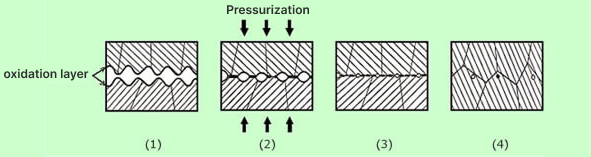
Diffusion bonding is a solid‑state joining process in which metal surfaces are pressed together at high temperatures below the melting point of the base material. The pressure is applied at a level that minimizes plastic deformation while still enabling atomic diffusion across the interface.
Heat and pressure flatten microscopic surface irregularities, allowing the original crystal grains to grow across the bonding surface. The result is a joint where the materials are bonded at the atomic level.
Diffusion bonding is used for:
- ・Laminating thin plates
- ・Forming complex flow paths
- ・Creating corrosion‑resistant structures
- ・Joining dissimilar metals
- ・Joining metals and ceramics
It is widely used in the semiconductor, aerospace, electronics, and energy industries.
Diffusion bonding commonly uses two pressurization methods: hot‑press furnaces and HIP furnaces. Each method suits different shapes and applications.
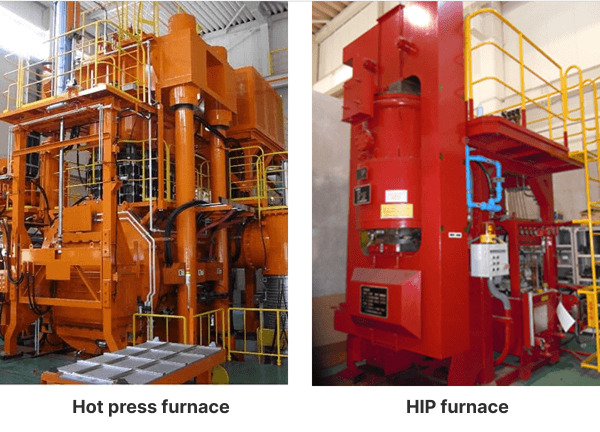
Hot Press
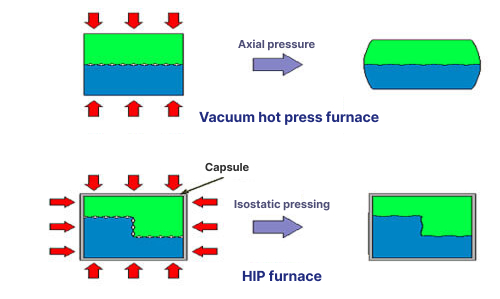
A hot press is a vacuum furnace equipped with a punch that applies vertical pressure. It is well suited for flat, thin components. A key advantage is its ability to bond parts while preserving hollow features such as water channels or internal flow paths.
Typical applications include:
- ・Heat exchangers
- ・Cooling plates
- ・Laminated structures with milled channels
HIP (Hot Isostatic Pressing)
HIP uses high‑pressure inert gas inside a pressure vessel. The components are sealed in a capsule, usually stainless steel, and bonded under uniform pressure.
Compared with a hot press:
- ・HIP applies higher pressure
- ・Compression occurs from all directions
- ・All internal gaps are eliminated
HIP is ideal for three‑dimensional shapes, including:
- ・Pipes
- ・Blocks
- ・Double‑walled structures
- ・Nested components
- ・Linings
Benefits of Diffusion Bonding
This section explains the five main benefits of diffusion bonding:
- ・High bonding strength and durability
- ・Low thermal deformation and residual stress
- ・Clean bonding surfaces
- ・Ability to support complex and hollow structures
- ・Compatibility with dissimilar and difficult‑to‑bond materials
High Bonding Strength and Durability
Diffusion bonding creates joints with exceptionally high strength because the base materials bond at the atomic level. No adhesives, fillers, or brazing materials are used. This means there are no physical or chemical discontinuities at the bonding interface. The joint achieves strength, toughness, and durability similar to the original material.
Diffusion‑bonded joints also perform well under long‑term cyclic loads, such as fatigue testing. This level of integrity is difficult to achieve with arc welding, spot welding, or other fusion‑based techniques.
When bonding dissimilar materials, diffusion bonding supports strong joints through mechanical interlocking and controlled formation of intermetallic phases. Even challenging combinations such as stainless steel and aluminum, or copper and titanium, can be joined with high reliability.
Low Thermal Deformation and Residual Stress
A key advantage of diffusion bonding is that it joins materials in a solid state. The materials are heated to a temperature below their melting point, typically between 500°C and 1,200°C, depending on the combination.
Traditional welding methods melt specific points of the material, causing local high‑temperature zones. This often results in warping, dimensional loss, and internal stress.
Diffusion bonding avoids these issues because:
- ・The temperature stays below the melting point
- ・Thermal gradients are smaller
- ・Rapid structural changes do not occur
This leads to excellent dimensional stability and minimal residual stress. These characteristics are essential for precision equipment, thin‑plate laminations, and structures where geometric accuracy must be preserved. Reducing residual stress also improves fatigue resistance and slows down long‑term degradation.
Clean Bonding Surface
Another important benefit is the cleanliness of the bonding interface. Processes like brazing, adhesive bonding, and many welding methods introduce additional materials such as fillers, flux, or adhesives. These often leave residues and impurities that weaken the joint, affect thermal and electrical properties, or accelerate corrosion.
Diffusion bonding eliminates this concern. Because the process joins only the base materials under high temperature and pressure, no foreign substances remain at the interface. Processing is performed in a vacuum environment, which reduces oxidation and other chemical reactions. The result is a clean, stable, and uniform joint.
Supports Complex Structures and Hollow Parts
Diffusion bonding is well suited for structures that cannot be produced through conventional welding. Since it bonds surfaces directly without rods, wires, or filler metals, it maintains internal cavities and fine channels.
Two main pressurization methods are used:
Hot Press Bonding
A hot press applies vertical uniaxial pressure inside a vacuum furnace. This method is effective for flat or thin components. It is especially valuable for structures that contain internal flow paths, such as:
- ・Laminated heat exchangers
- ・Cooling plates
- ・Multi‑layer plates with machined channels
These hollow features remain intact during bonding.
HIP (Hot Isostatic Pressing)
HIP applies uniform pressure using high‑pressure inert gas inside a sealed vessel. Parts are placed inside a capsule and bonded under equal pressure from all directions.
HIP enables bonding of:
- ・Three‑dimensional shapes
- ・Pipes and blocks
- ・Nested structures
- ・Double‑walled tubes
- ・Linings and cladding structures
Because all voids are eliminated during compression, HIP is ideal for complex geometries that require full densification.
Applicable to Dissimilar and Difficult‑to‑Bond Materials
Traditional welding often struggles with dissimilar metals. Differences in melting points, thermal conductivity, and the formation of intermetallic compounds frequently cause defects or weak joints.
Diffusion bonding avoids these issues because the base materials do not melt. Bonding occurs through atomic diffusion at elevated temperatures, which reduces thermal stress and limits unwanted chemical reactions. This allows stable bonding of combinations such as:
- ・Titanium and aluminum
- ・Copper and stainless steel
- ・Other material pairs that are difficult to join with fusion‑based methods
Examples Where Diffusion Bonding Is Required
Two common applications illustrate where diffusion bonding provides clear advantages:
- ・Manufacturing hollow or internally‑channeled components
- ・Bonding dissimilar metals
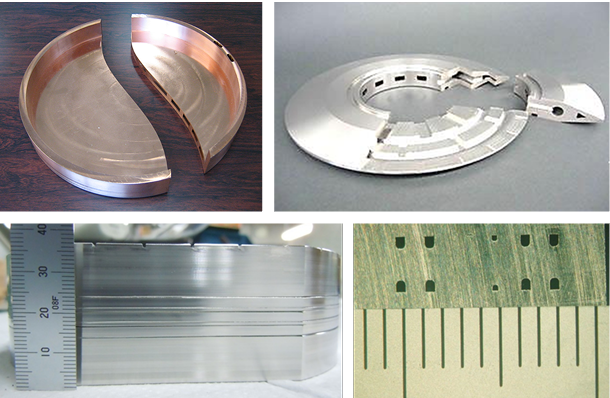
Manufacturing Hollow-Shaped Parts (Hot Press)
Hot‑press diffusion bonding is ideal for components that contain hollow sections, internal cavities, or fine channel networks.
Typical examples include:
- ・Cooling plates
- ・Resin molding dies
- ・Heat exchangers
- ・High‑performance heat sinks
Internal channels are machined into metal sheets before assembly. The sheets are then stacked and diffusion‑bonded. This process preserves the internal geometry with:
- ・High airtightness
- ・High dimensional accuracy
- ・No collapse of delicate internal structures
The result is a compact, efficient component that traditional welding cannot produce without deformation or blockage.
Bonding Dissimilar Metals (HIP/Hot Press)
Diffusion bonding supports strong, stable joints between metals with very different properties. Stainless steel, aluminum, and copper are common examples of difficult combinations using welding, but they can be joined through diffusion bonding with high reliability.
Benefits include:
- ・Reduced formation of brittle intermetallic compounds
- ・Suppressed internal stress during bonding
- ・Lower risk of cracking or delamination
- ・More stable long‑term performance
Both HIP (Hot Isostatic Pressing) and hot‑press bonding are used depending on the part geometry and required bonding pressure.
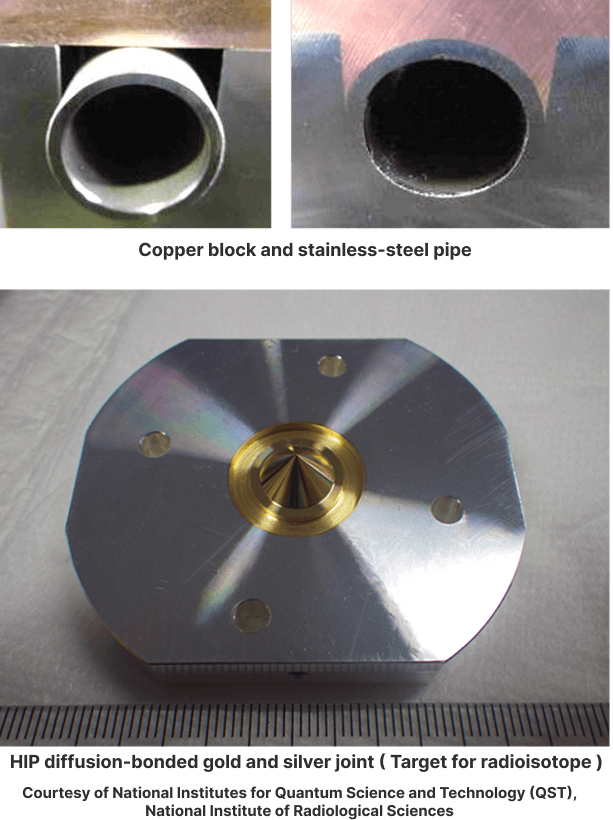
Material Combinations and Application Examples (HIP)
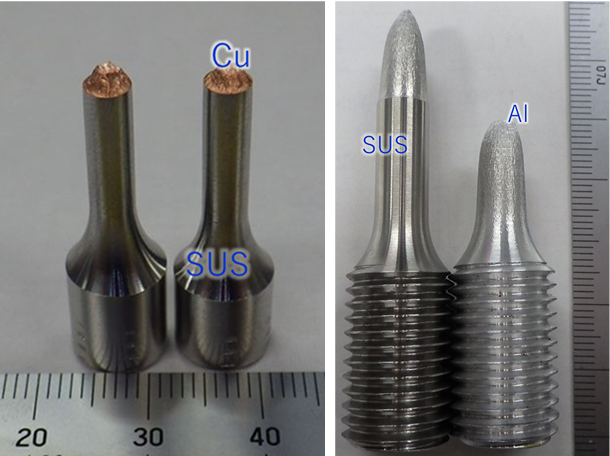
- ・A copper block and stainless steel pipe: utilize the high thermal properties of copper and the corrosion resistance and strength of stainless steel
- ・Stainless steel and aluminum pipe joints: bonding joints for connecting stainless steel piping and aluminum piping
- ・By combining precious metals with lower‑cost materials that offer high thermal conductivity, such as copper, overall material costs are reduced while maintaining functional performance.
Summary
This article outlined the fundamentals of diffusion bonding, its key benefits, and common application examples. Diffusion bonding provides high‑strength, clean joints and supports complex structures as well as combinations of dissimilar materials. These strengths make it valuable for manufacturing hollow components, multi‑layer structures, and reliable joints between metals with significantly different properties.
At MTC, we offer diffusion bonding services using both HIP and hot‑press systems. Our equipment supports a wide range of materials and shapes, delivering strong, precise, and stable bonds. If you need guidance or support with diffusion bonding, please contact us.
Related Information
Click here for Kinzoku Giken's Hot Press (Diffusion Bonding)