

Hot Pressing: Types and Features Explained
Column
Contents
Overview
Hot pressing applies heat and pressure to a material to achieve bonding, sintering, or forming.
Different types of hot press equipment are used depending on the application. Below is an explanation of the major differences, characteristics, and uses of hot press systems.
What is Hot Pressing?
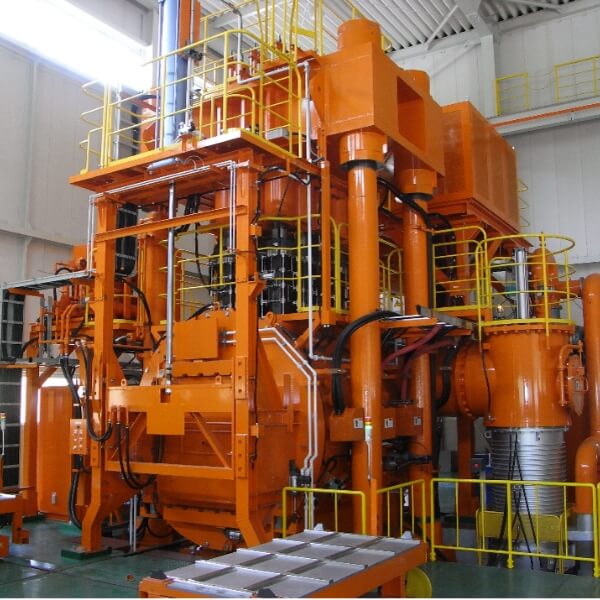
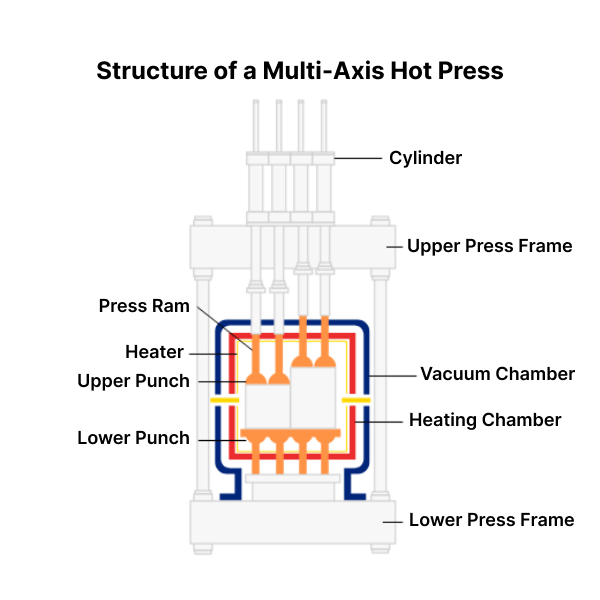
Our equipment is vacuum hot press machinery designed to heat metal or ceramic blocks, plates, and powders in a vacuum environment. A hydraulic press then applies pressure to bond or sinter the material.
When pressure is applied at room temperature, strong metals resist deformation and return toward their original shape. This makes many high‑strength materials difficult to process. By heating the material below its melting point, hot pressing softens it and enables bonding or forming that is not possible at room temperature. As the material cools, it hardens and its strength increases, which is one of the key advantages of the process.
Hot presses are available in uniaxial and multiaxial configurations. Uniaxial systems apply pressure from a single axis. Multiaxial systems apply pressure from multiple axes and provide a larger working area, allowing the processing of bigger or multiple components at once.
A related technology is HIP (Hot Isostatic Pressing). Unlike hot pressing, which applies pressure from one direction through a punch, HIP applies uniform pressure from all directions using high‑pressure gas. Hot pressing is well suited for thin or plate‑type materials, while HIP uses a sealed metal capsule and supports bonding of three‑dimensional or complex shapes. Selecting between hot pressing and HIP depends on cost, geometry, and the required material properties.
Types of Hot Presses
We operate two primary types of hot presses: bonding hot presses that bond materials with high temperatures and pressure of approximately 480°C to 1,200°C, and sintering hot presses that can heat and pressurize at even higher temperatures than bonding presses, around 2,000°C.
01. Bonding Hot Press
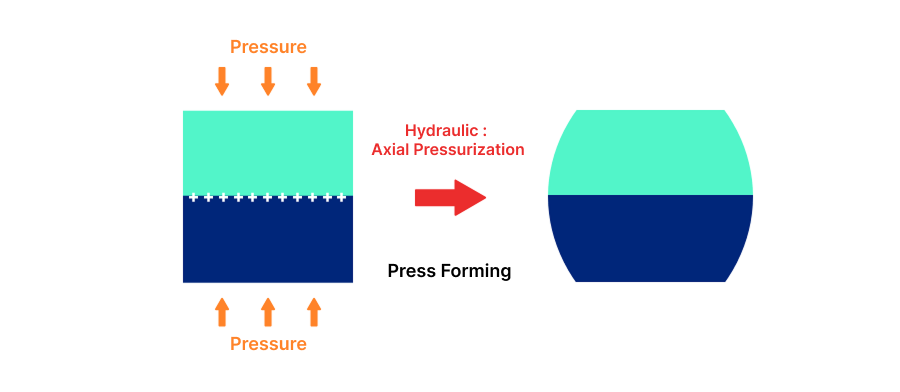
A bonding hot press is used to join metal materials under high temperature and pressure. The process promotes molecular bonding and produces strong joints without welding filler materials. It supports bonding of both similar and dissimilar metals and is used for components such as heat exchangers, heat sinks, mold assemblies, and heat‑dissipation plates. Uniaxial presses are compact and suitable for small parts, while larger materials require a multiaxial press.
02. Sintering Hot Press
A sintering hot press supports materials that bonding presses cannot process. It uses the same basic structure but operates at much higher temperatures, often reaching around 2,000°C depending on the unit. This allows sintering of refractory metals and ceramics.
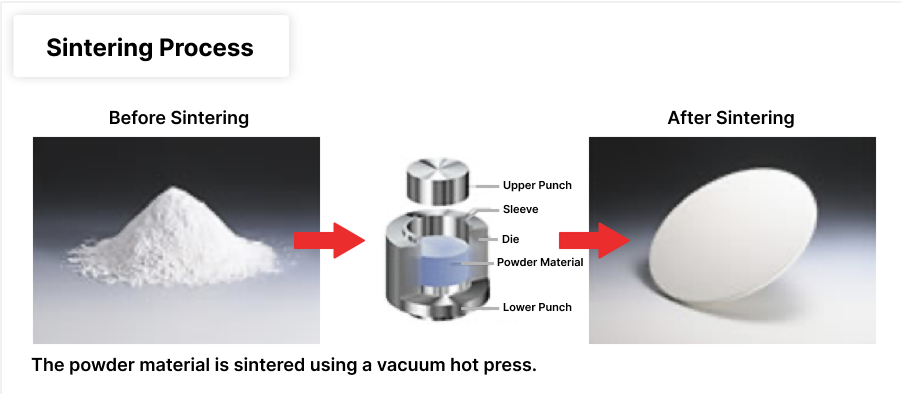
Sintering heats metal or ceramic powders below their melting point while pressure increases particle bonding and density. Powder materials offer greater freedom of shaping than molten metals and allow the processing of metals that are difficult or impossible to cast.
What Hot Pressing Enables
Hot pressing supports:
- ・Powder sintering
- ・Diffusion bonding of similar or dissimilar materials
Because it also functions as a heat‑treatment method, it can improve strength and achieve specific desired properties in the finished product.
Powder Sintering
Powder sintering places metal powder into a carbon or similar mold. Heat and pressure transform the powder into a dense, high‑strength part. Any metal that can be powdered can be sintered, including high‑melting or difficult‑to‑machine materials. Compacted powder bodies formed by adding metal powder and binders can also be sintered.
Diffusion Bonding
Diffusion bonding applies heat and pressure to join metal surfaces without melting them. The process removes oxide layers and creates a clean metallic bond. Joint strength is equal to or greater than the base material, and no brazing filler or adhesive is used, avoiding concerns about degradation at the bonding interface. This method is effective for metals that are difficult to braze or weld and for applications requiring large bonding areas.
Diffusion bonding can be performed with bonding presses, sintering presses, or HIP. However, because hot presses apply pressure from one axis, they cannot bond three‑dimensional surface shapes. HIP must be used when the bonding surfaces are complex or fully three‑dimensional.
Summary
Hot pressing and HIP are key technologies for diffusion bonding and sintering of both similar and dissimilar metals. They also support high‑density forming of metal materials through combined heating and pressurization.
MTC operates more than 30 hot press and HIP units worldwide. With long‑developed technical expertise, strict quality control, and integrated in‑house production, we provide solutions tailored to each customer’s requirements.
If you are exploring ways to solve metal component challenges, prototype parts, reduce weight, or increase strength, please contact us through the inquiry form.
Application Fields and Materials
| Application Fields | Aerospace, semiconductor manufacturing equipment, electronic materials, energy, accelerator, automotive-related, medical devices, electronic devices, precision instruments, chemical equipment-related, etc. |
|---|---|
| Applicable Materials | Electronic materials, magnetic materials, refractory materials, heat-resistant materials, corrosion-resistant materials, cemented carbide, stainless steel, titanium alloys, aluminum alloys, copper alloys, iron alloys, ceramics, amorphous materials, resins, etc. Through lining with base materials, combinations are diverse. |